Review: The Menu – “obsession gets all of us on the menu.”
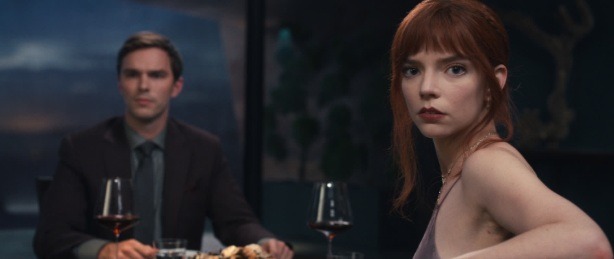
A brilliantly bitter satire of fine dining and wealth, Mark Mylod’s dark comedy presents its wealthy customers with a tasting menu they will never forget—nor survive.
There is something that feels odd about a trip to a restaurant that costs so much yet makes nobody happy. The food is impeccable, the atmosphere is terrific, and the service is second to none, yet each of the guests seems to be unhappy. Welcome to Hawthorn. Chef Julian Slowik (Ralph Fiennes) has selected a very special evening for these diners who made a fortune for the meal and only for it.
Mark Mylod’s The Menu begins with a sophisticated satire of the fine dining world, but as the night progresses, things quickly take a darker turn in each new course served to the guests. Visitors come to a secluded island, where they are welcomed by a team of chefs whose professional politeness feels almost disturbing.
While the guests cannot make heads or tails of what they are dining on, they know they are supposed to love it.
Fiennes’ portrayal of Slowik is at the heart of the film; he is anxiety-inducing but calm enough to make a speech about existence while serving his guests their final meal. Slowik is not just a chef; he is almost religious in his methods of feeding his guests. The meals are accompanied by parables and morals, leading the patrons to the realization that they are no longer customers—they have become part of the menu.
The visitors are a truly unpleasant mixture of those who have had too many advantages in life. They include a rich couple who have been to Hawthorn several times but never remember what they consumed on those occasions, a very self-important food critic along with her very loyal editor, a movie actor trying to prove that he is still needed, and Tyler, who is one quite annoying food lover who knows a lot about the chef’s meals but nothing else.
Finally, Margot.
Slowik is aware that she has no business being there. And while the others are mesmerized by the elaborate rituals of the evening, Margot appears to be more concerned with asking several straightforward questions. Why is everybody else behaving so weirdly? Why are they there? And why does the place no longer seem like a restaurant but a cult of some sort?
Margot is played wonderfully by Taylor-Joy, who brings to life the complete combination of toughness and sensitivity. Fiennes fits the role of the man who turned his hobby into a form of a religious column perfectly. The nature of their relationship creates the film’s most interesting tension.
The film’s real target, however, is not food. It is consumption.
Slowik is appalled at those that consume his culinary creations without truly grasping their significance. His patrons crave extravagant ingredients and elaborate methods and fascinating stories to share with their supper guests. They have made the process he once enjoyed deeply frustrating.
Such irony is positively succulent.
They are annoying, and Slowik detests the manner in which they engage with his new art form, but ultimately Slowik’s obsession with extraordinary perfection leaves him nowhere to run. Somewhere on his journey towards achieving uniqueness, the enjoyable aspect of cooking has dissipated, and it has in fact turned into a joyless production where the chef has assumed the role of a dictator and the customers have become enemies.
Yet, everyone orders the food nonetheless.
Mylod cleverly allows himself to become immersed in the absurdity of the genre of satire. Every following course in the restaurant is more complicated and shocking than the previous one, while workers preserve their strange professionalism. Even when events are heading toward pure horror, the film is bearing the sense of humor. This is why it appears to be a kind of weird mixture of comedy, thriller and social satire that can turn luxury food into an extremely funny and dreadful thing.
The film is not perfect. There are a number of extremely exaggerated characters; also, the filmmakers make social issues too evident for anyone to think about. At times Slowik’s ideas sound almost too theatrical. However, The Menu shows that one needs little subtlety of an expert if the guests are already present at the table.
And then the cheeseburger follows.
The ending of the movie informs us, without revealing the biggest secrets, that the cheeseburger is probably one of the most brilliant features of the movie. After watching so many detailed presentations of various dishes and listening to the complex terms used in the culinary world, in fact, Slowik most craves something as basic as food that someone prepared just for the mere pleasure of eating it.
For all its bloodshed and black humor, The Menu ultimately asks a surprisingly simple question: why do we turn the things we love into things we can no longer enjoy? Whether it is food, cinema, or even something as simple as Pusoy online, enjoyment can lose its meaning when the experience becomes more about consumption than pleasure.
Food becomes art. Art means status. Status means obsession. And obsession gets all of us on the menu.
Trailers
Support Live For Films
Follow Us




Advert
Recent Posts


Film Festivals and Conventions







Check out these other sites