TIFF 2026 Review – Everest: The Other Side – “Those with a fear of heights will yet again get sweaty palms in some scenes.”
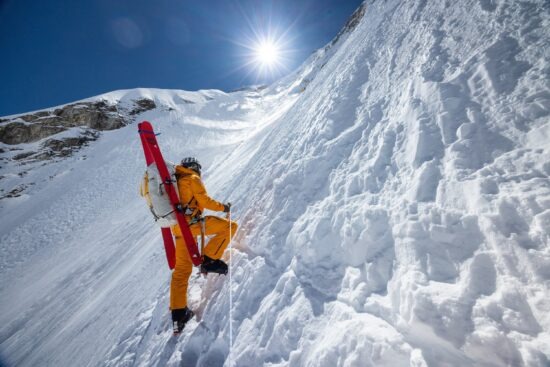
Jim Morrison climbs Everest. (mandatory credit: Jimmy Chin). courtesy of TIFF
For those of us who don’t indulge in adrenaline-inducing activities, the thought of climbing Mount Everest seems not only impossible, but also a little silly. Why, on earth would you put your body through one of he toughest endeavours known to humankind, dodging avalanches, storms and facing the cold and low oxygen? For Jim Morrison, the summit of Everest is a calling, and to do it from the north face, something only 5 other people have ever accomplished, is how it must be done.
Everest: The Other Side is directed by Oscar winners Elizabeth Chai Vasarhelyi and Jimmy Chin. But the story they were trying to tell had a tragic and abrupt end. As Vasarhelyi says on camera, their initial goal was to tell the story of Hilaree Nelson, a professional ski mountaineer and mother of two. With her partner, Jim Morrison, they were meant to scale Everest together. But, in a jaw-dropping moment captured on camera, Nelson disappears in an avalanche. Morrison eventually recovers her body from under the snow. But, the woman whose mantra was “Die young, as late as possible” has fallen to the sport and the risk she always knew was present.
So, the filmmakers do what they have to do to tell a story, they pivot. It only takes 7 months for Morrison to work through his grief enough to justify heading back to Everest to finish what he and his partner started. This time, he takes friend and filmmaker Jimmy Chin, now in front of the camera, along for the ride. This to the chagrin of Vasarhelyi, who is not afraid to show their difference of opinion on his travel (whether this led to their eventual divorce announcement is not confirmed but based on the interaction I wouldn’t be surprised!)
What follows is, as you might expect, a record of the crew’s planning, their climbing, their setbacks, including a full postponement for a year after a member of the crew breaks his leg and conditions are only then deemed too dangerous. If you’ve seen the directing duo’s other films, you’ll see elements of their previous films in this one. There’s the gut-wrenching footage of heights during their climb, similar to the vertigo-inducing visuals of Free Solo. There’s a moment of The Rescue where they bring the aforementioned injured man down from 26,000 feet to safety. There’s even an aspect of Love + War initially when they talk to Nelson about how she can find balance between her risky passion and her family life (for the record, she says there is no balance, just chaos). It is their niche, certainly, but it feels almost repetitive.
What’s also somewhat disappointing is that there is another, even more interesting story at the heart of Everest. That of the Sherpas. They are the legitimate heroes of this trek – making their way up the mountain first, forging a path, setting up camp and climbing ropes for the ‘foreigners’. While Morrison and Chin sit down in the relative ‘comfort’ of the base camp, the Sherpas are taking equipment up to dizzying heights. Yes, for some of them, climbing the north face is also a dream, but for others it’s not worth the risk in the end. They don’t want to take orders from these outsiders, and several end up leaving. It’s the source of livelihood for many of their families. As we get to know Yukta, the lead Sherpa on their mission and the one who gets injured, I found myself more drawn to him and the lifestyle of these men, which would be a compelling story in its own right.
As in their previous documentaries, the cinematography here is spectacular and seeing it in IMAX really has full impact. Listening to the wind whip through the mountains and the snow blow over the crests is chill-inducing. Those with a fear of heights will yet again get sweaty palms in some scenes. And the first-person footage of Morrison skiing down the north face of Mount Everest is harrowing, as is the tale of his tragic past. One can theoretically see why he would want to finish what he and Hilaree Nelson set out to do. But, just as in Free Solo, there is the question as to how selfish this endeavour really is when it has the potential to hurt those you love. In pursuing her passion, Nelson left her two sons behind (as well as the adorable labradoodle Winston). Is the sorrow of her family worth the accomplishment of climbing a mountain? I suppose that’s up for the viewer to decide, as the filmmakers don’t really delve into this question. And perhaps your enjoyment of Everest: The Other Side will depend on whether you can reconcile watching these people continually put themselves at risk in the name of grief.

Everest: The Other Side had its Canadian premiere at the 2026 Toronto International Film Festival on Saturday, September 12th. For more information head to tiff.net
Trailers
Support Live For Films
Follow Us




Advert
Recent Posts


Film Festivals and Conventions







Check out these other sites