5 Action Movies That Feel Like Competitive Shooter Games
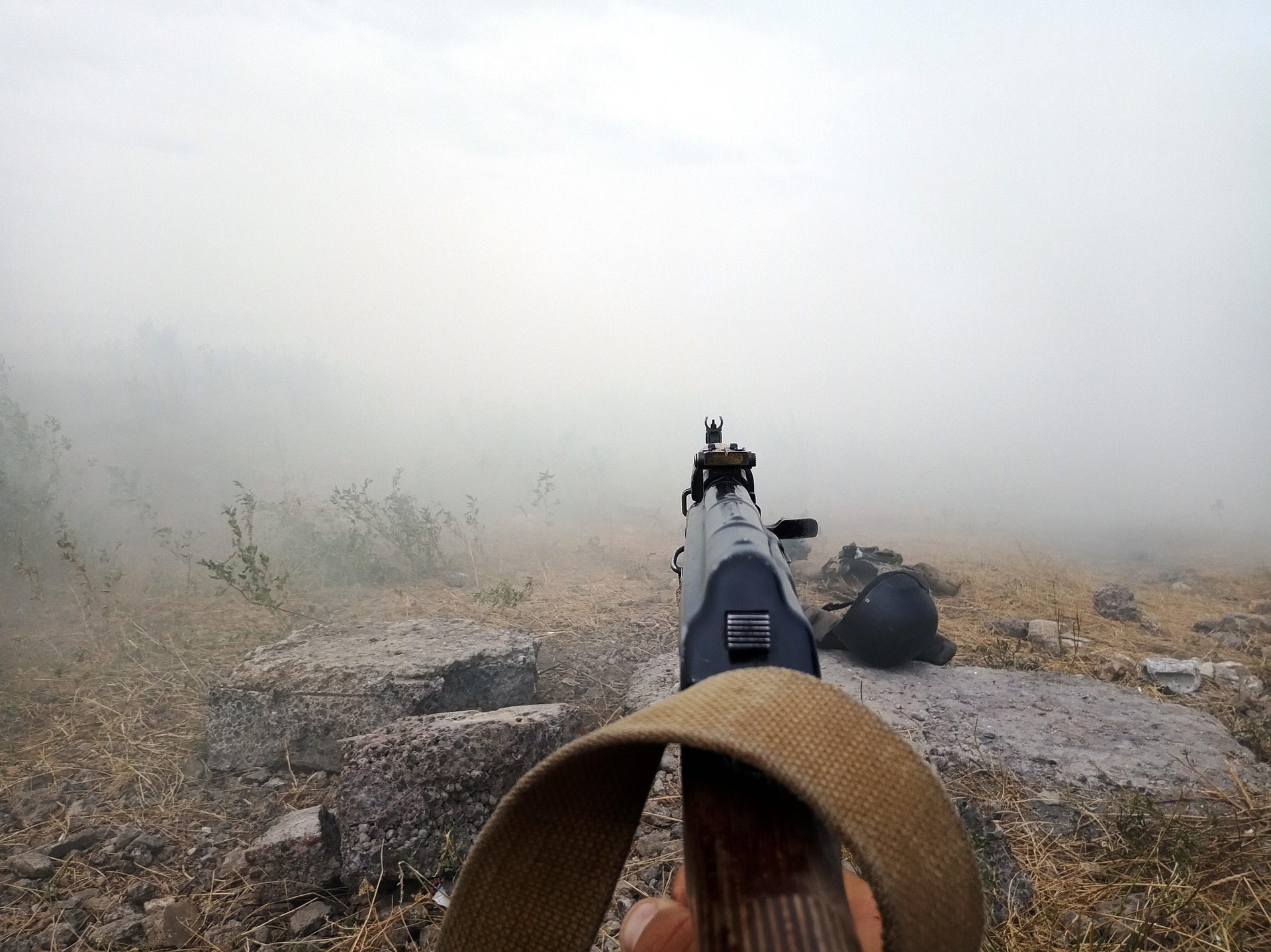
There’s a certain kind of action film that plays differently from the rest. The shootouts are slow-burning before they detonate. Movement through space actually matters. Characters die because of positioning, not because the script decides it’s their time. It’s not hard to see why these films resonate so strongly with people who spend time in games like Rainbow Six Siege or Valorant – the underlying logic is the same.
That crossover between cinema and gaming isn’t a recent phenomenon. As we’ve explored before in our look at the best films with gaming elements, filmmakers have long borrowed ideas from games, and the traffic runs in both directions. But the five films below aren’t adaptations or homages – they just happen to share the same DNA as competitive shooters: tight maps, deliberate movement, and the constant weight of consequence.
Heat (1995)
It would be almost impossible to talk about this subject without starting here. Michael Mann’s crime epic Heat has had a long reach. Analysts writing in a military analysis noted that military and law enforcement agencies later studied the film’s downtown Los Angeles shootout for its unusually accurate depiction of small unit tactics under pressure. The Grand Theft Auto franchise borrowed from its visual and narrative language.
The film itself is a three-hour procedural about two professionals on opposite sides of a coin – Neil McCauley (Robert De Niro), a disciplined career criminal, and Vincent Hanna (Al Pacino), the detective who mirrors him. Mann keeps the camera at the level of craft throughout: how McCauley scouts a location, how his crew moves in formation, and how information travels between them under duress.
The downtown shootout is the clearest illustration. After a bank heist goes wrong, both sides spill out onto a Los Angeles street in broad daylight. What follows is five minutes of controlled chaos – real firearms handling, proper use of cover, and reload discipline. No slow-motion. No flourish. Players who understand the geometry of a Rainbow Six map will watch it and feel instantly at home.
The reason it hits so hard is the same reason a well-executed competitive round hits hard. Everything that leads to that moment was earned. All the planning, the scouting, the near misses. Mann builds the film so that by the time the guns come out, you understand exactly what everyone is trying to do and what it costs when it falls apart. People curious about what Black Ops 7 boosting looks like when done at a high level with elite coordination and the kind of pressure management you do not often see will recognize something similar in McCauley’s crew.
Sicario (2015)
Denis Villeneuve’s drug war thriller is less interested in spectacle than in atmosphere. Sicario is built around the experience of not knowing – FBI agent Kate Macer (Emily Blunt) is inserted into a shadowy inter-agency task force and given no useful information, which means the audience knows exactly as little as she does.
The operational sequences carry a genuine procedural weight. A border crossing breakdown captures it well. When the firefight erupts, it is over in seconds. There are no quips and no elaborate stunts. The tactical team neutralizes threats with a cold efficiency that would feel at home in a Siege round and then immediately moves on. Villeneuve commits to showing the aftermath without softening it.
Roger Deakins’ cinematography is a major part of why it works. A few things he does that any FPS player will immediately clock:
- Overhead drone shots that function exactly like a tactical overhead view
- Heat-signature night-vision sequences that strip the action down to silhouettes and movement
- A convoy sequence shot mostly from inside vehicles, keeping the viewer ground-level and disoriented
The film puts the viewer into the headspace of someone watching a minimap while simultaneously being inside the action. That dual perspective – strategic overview and ground-level tension – is a feeling any Valorant player knows from a particularly high-stakes round.
Sicario is not a fun film in the traditional sense. But it is a masterclass in how to make the audience feel the weight of a situation without explaining it to death. The information asymmetry that makes competitive shooters so punishing is baked directly into its structure.
John Wick (2014)
The John Wick films occupy a slightly different space on this list because their action is more stylized. Nobody is pretending that one man moving through a gun-filled nightclub is documentary realism. A choreography analysis explains what director Chad Stahelski actually built. A fighting system rooted in jiu-jitsu, judo, and tactical gunplay designed to be performed in wide unbroken shots so the spatial logic remains legible throughout.
That spatial logic is the point. John Wick moves through environments the way a top-ranked player moves through a server – constantly thinking about angles, distances, and the next threat. He doesn’t stand in the open. He doesn’t ignore a flank. When he runs out of ammunition, he transitions immediately to whatever the next viable option is. The choreography makes the decision-making visible in a way that standard action films rarely do.
John is essentially playing a game with a very bad spawn rate and no respawns. The film knows this and treats it accordingly – each environment is a level with its own set of rules, and Wick figures those rules out in real time while his opponents try to adjust. It’s the kind of analytical approach to violence that competitive FPS games reward and Hollywood usually ignores.
Dredd (2012)
Dredd deserves a spot on this list for one reason above all others: it commits completely to its premise and never flinches. Judge Dredd (Karl Urban) and a rookie judge are trapped in a 200-floor tower block controlled by a crime lord and must fight their way through it floor by floor. That’s the whole film. No subplots, no relief, no sentimentality.
The tower block structure maps almost perfectly onto a vertical competitive map. Siege players will clock it immediately – the film works through:
- Controlled corridors with limited sight lines and no safe open ground
- Improvised cover using whatever the environment offers
- Multi-floor vertical pressure, with threats above and below at the same time
- The constant uncertainty of what is waiting behind the next door
The film’s low budget actually works in its favour here: there’s no money for wide exterior sequences, so almost everything is contained within the building, which keeps the spatial tension constant.
Urban’s Dredd is also worth noting as a character. He speaks in short declarative sentences and doesn’t editorialize about his situation. He reads his environment, makes a decision, and acts. He’s a playable character who happens to be in a film – the opposite of the usual Hollywood protagonist who narrates their own competence through witty one-liners.
Extraction (2020)
Sam Hargrave’s Netflix action film is the most explicitly game-like entry on this list, and that’s partly by design – Hargrave spent decades as a stunt coordinator before moving to directing, and the film’s most celebrated sequence, a twelve-minute-long continuous shot following Chris Hemsworth’s mercenary through a collapsing extraction operation in Dhaka, Bangladesh, is structured and shot like something between a third-person shooter and a competitive FPS.
The one follows Tyler Rake through a series of escalating encounters: car to foot chase, foot chase to close-quarters building interior, and building interior to rooftop. Each transition feels like a level change. The camera stays tight on Rake’s decision-making throughout – where he goes for cover, how he manages the child he’s protecting, and how he adapts when the situation changes faster than he can plan for.
Recent action cinema – like Jack Ryan: Ghost War, which similarly treats operational logic as a storytelling device – suggests the appetite for this kind of procedural action isn’t going anywhere. Audiences, particularly those who grew up playing games that reward situational awareness over reflexes, increasingly respond to films that take the mechanics of a firefight seriously. These five do it better than almost anything else in the genre.
What separates Extraction from pure action spectacle is the operational context. Rake isn’t superhuman. He takes damage that accumulates across the sequence, and Hargrave actually shows this – slower movement, blood, and decisions made under compounding physical stress. It’s the kind of film that makes you think about stamina and resource management in a way that competitive game players will find intuitive. You don’t always have full health going into the next encounter. You deal with what you have.
Trailers
Support Live For Films
Follow Us




Advert
Recent Posts


Film Festivals and Conventions







Check out these other sites