Review: Blue Film -“a compelling two-hander character study”

It may be the most controversial movie of the year, given its taboo subject matter, and yet Blue Film is not on a mission to be provocative for provocation’s sake. If anything, it sets out to challenge audiences and stimulate reflection over the complexities of the human condition and it does so with a level of honesty and rawness that’s hard to find these days.
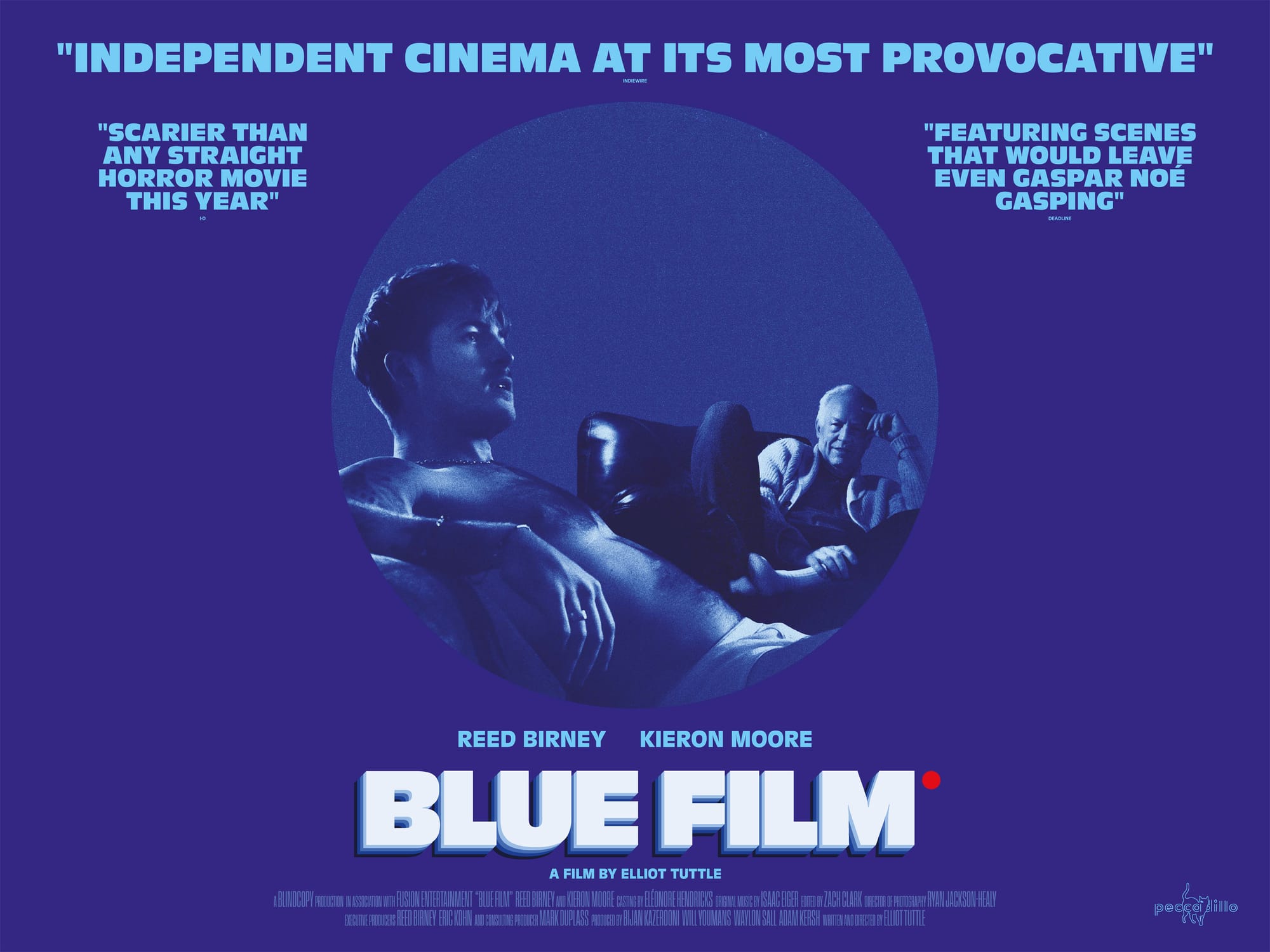
Revolving around fetish camboy Aaron Eagle (Kieron Moore) who – MINOR SPOILER – gets “catfished” by his former high school teacher and convicted paedophile Hank Grant (Reed Birney), Elliot Tuttle’s feature debut is the epitome of independent cinema with its two characters in one location and a $50k budget (plus another $50k for post-production).
Rejected by Sundance, South by SouthWest and several other festivals, this impressive first film most certainly owes a lot to the folks at Edinburgh Film Festival who recognised its potential and hosted its world premiere in their dramatic competition during last year’s edition, thus leading to a few other marquees getting “bold” enough to include it in their lineups as well, and eventually landing distribution for a limited theatrical release in the US back in May and the UK in September, courtesy of the British queer cinema pioneers at Peccadillo Pictures.
The opening sequence is a cringeworthy yet pitch-perfect character introduction for our protagonist. Entertaining his viewers on his saucy channel, wearing only tighty whities, Aaron claims to have just returned from the gym and keeps addressing his eager viewers with homophobic slurs as they are begging to see more but he won’t budge until they keep filling the virtual tip jar. Before ending his broadcast, Aaron reveals that he’s off to see someone who’s offered $50k to spend the night with him. Jump cut to a man masked in a balaclava who shuts off his laptop, having just watched the show. He’s the mysterious client Aaron is about to meet.
This, however, isn’t your typical online hookup or average sex worker gig. The balaclava and the recording camera may be familiar kinky territory but Aaron is shaken and ready to leave when the masked man begins to pressure him to talk about his real self behind the “Aaron Eagle from Miami” persona created for his OnlyFans. Then, a mutual unmasking kicks the film into gear as the client reveals how he knows that Aaron is actually Alex McConnell from Maine and Aaron literally pulls the balaclava off the man’s head to find his former high school teacher, Hank Grant.
What started off like a taut psychological thriller now turns into a claustrophobic game of philosophical chess, where these two characters, after a couple of failed attempts to call it quits, reluctantly and at the same time eagerly, settle in what almost feels like a Stockholm syndrome stronghold with each other, over a long night in a Los Angeles Airbnb. The result is a piece of filmmaking that could perfectly work as a theatre play but it’s rendered beautifully cinematic by Ryan Jackson-Healy’s slick cinematography and Zach Clark’s tight editing.
Why has a formerly convicted paedophile (who didn’t fully succeed and was jailed for attempted assault) traveled from Maine to California to spend £50k on a former student’s adult services? And why has Aaron chosen this path in life? The answers are not simple and straightforward. This is a compelling two-hander character study on sexuality, toxic masculinity, nature vs nurture and what drives the life choices we make. The way it unfolds follows the rhythm of how much these two men are willing to open up and become vulnerable, which happens to be unsurprisingly challenging for both.
Despite the reported walkouts in some screenings, and respectfully appreciating how we all have a different tolerance threshold when we’re exposed to something uncomfortable, the paradox is that Blue Film isn’t extremely graphic. I’ve seen way more explicit depictions of sex on screen. The truly unsettling element of the narrative is the unravelling of these two characters’ psyches and the way their confrontation lays their souls bare. By the time they’re finished with each other, the viewers’ heads might as well explode after being pushed to the brink of moral ambiguity.
In his director’s statement, filmmaker Elliot Tuttle has defined his film as “an essay on perversion” but not just in the obvious sense you might immediately think about. He explains how his frustration with the conceptualised rendition of sex in films compelled him to write something that would explore the uncomfortable and scary side of it. Granted that this is not suitable viewing for any victim of abuse, Tuttle is not trying to make statements on the topic of paedophilia but he makes an interesting argument when saying that “very few people are paedophiles but all of us, in some ways, can relate to the idea of taboo desire”.
Now, none of it would work in the slightest if it wasn’t for the monumental performances by Tony Award winner Reed Birney and breakthrough star on the rise Kieron Moore. Birney is magnetic in the way he embodies a controversial character like Hank and finds the right balance between manipulation and empathy, throwing in a little dose of tension-breaking humour as well. Moore on the other hand is a revelation in selling the dichotomy between the hypermasc camboy who’s actually proud of what he does for a living and the sensitive soul he’s tried to repress.
In the best tradition of thought-provoking cinema, Blue Film leaves the audience plenty of room for reflection on the themes it explores, never providing easy or predictable answers. It is indeed a difficult watch but it’s also a rather rewarding one, especially for viewers like me who need some form of emotional connection and by the time the screen fades to black, there’s no doubt it manages to strike a chord as a melancholic, moving piece of storytelling.

Blue Film is available now on digital platforms.
Trailers
Support Live For Films
Follow Us




Advert
Recent Posts


Film Festivals and Conventions







Check out these other sites