Review: Forgotten Island – “This is a visual film. It is loud and complex and kinetic.”
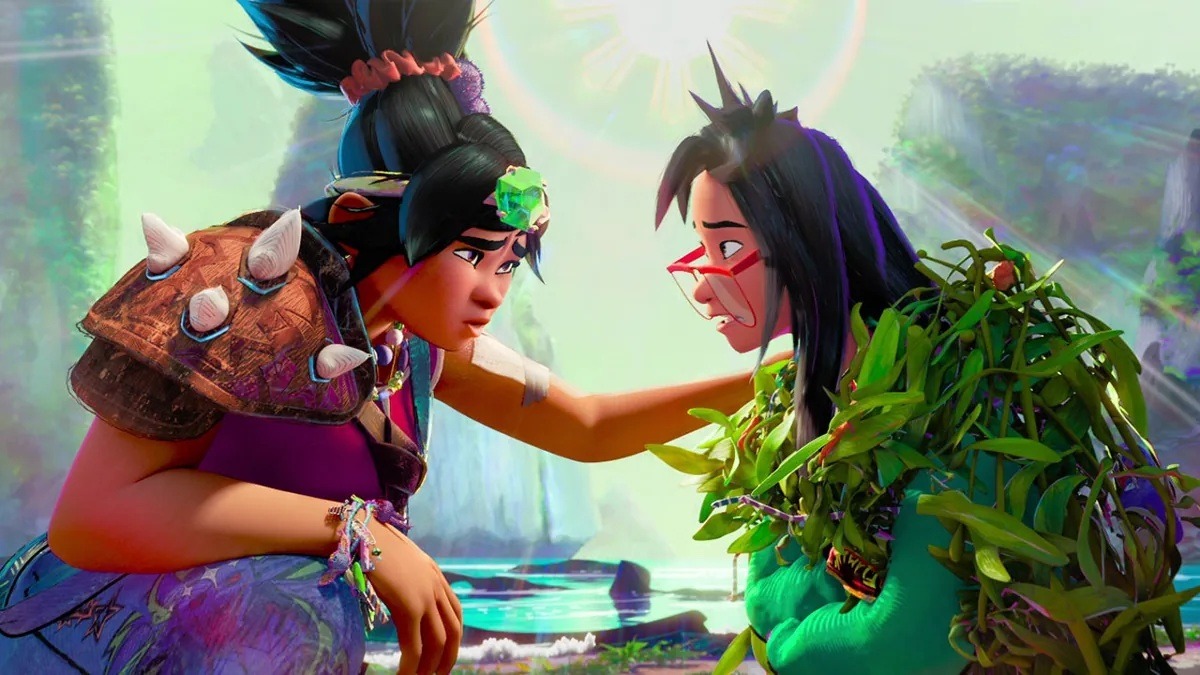
Okay, so the headline is: Forgotten Island successfully papers over a multitude of cracks by throwing enough colour and movement at its intended audience to distract from the flaws.
It did manage to make me tear up, so I must have liked it, but in a “hey, this actress (turns out to be Liza Soberano) is really selling this” way, rather than the guaranteed weeping of Pixar or The Wild Robot.
Quick rant, I avoid trailers as much as possible because of spoilers. Forgotten Island’s trailer commits the much worse sin of actively misleading the audience about the nature of the setting and the antagonist.
Having seen the trailer, I was genuinely confused by several parts of the film. That feels like something that only happens if something is very wrong with the setup. If you have a strong story setup, then you should be able to articulate that in the trailer.
We should definitely start with the visuals, because this is a visual film. It is loud and complex and kinetic; you can draw a line from Spider-Verse, through KPop Demon Hunters, to this film. That sort of energy is right up my street. I love it. I think animation has been far more interesting than live action for at least a decade, and Forgotten Island is an extremely solid example of something that looks bang up to date and fashionable. The problem, of course, is that being bang up to date and fashionable is very different from being groundbreaking or genre-defining. The visuals are the best thing about the film and, other than some cleverness around space, perspective and tracking shots, they aren’t doing anything particularly new.
The underlying theme is friendship. Although “underlying” is hardly the word when the preview screening included a “make your own friendship bracelet” activity (My eight-year-old loved it; I am in Dad of the Year territory). Friendship is given more space here than “family” in a Fast & Furious movie.
There are two girls here who are fundamentally unhappy apart and happy together. One of them is shortly moving away to university (the film is set in an era of mixtapes and landlines, so this is a big deal). It’s a slight shame that, as a theme, I thought it was handled so much better in the recent live-action Lilo & Stitch.
I note that both directors are credited as writer-directors, with their only writing credit, and that does nothing to dispel the feeling I got that the script was an afterthought to the visuals. Characters act in ways that make no sense either at the time or when their later motivations are revealed. Plot threads are developed and then dropped. Plot difficulties are literally solved by saying, “It’s magic.” Characters develop powers when the plot requires them. A human character demonstrates the ability to fart an enormous amount of fire early in the movie, but it was already clear that this was not the sort of narrative in which that was ever going to turn out to be a Chekhov’s gun, which was a relief.
For what it’s worth, I suspect the target audience won’t care much about the writing. But I will say this: at my review screening, which was full to bursting with excited kids full of free sugar, there were zero audiable laughs. By contrast, during Minions & Monsters — which I hated, and which I had to see twice — I was surrounded by kids laughing like drains.
Trailers
Support Live For Films
Follow Us




Advert
Recent Posts


Film Festivals and Conventions




Check out these other sites