TIFF 2026 Review: Fjord – “What powers the film is the subtle performances from Renate Reinsve and Sebastian Stan.”
Courtesy of TIFF
A fjord is an inlet in the ocean surrounded by towering rocks. They’re an incredibly beautiful part of Norway’s landscape. But for some areas, it seems incredibly isolating. The community at the heart of Cristian Mungiu‘s Fjord is one such place – small, where everyone is a neighbour, though not everyone may be a friend.
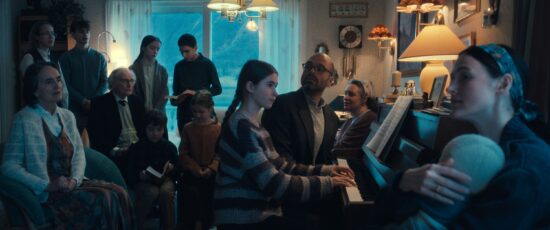
“You have to learn to admit when you’re wrong,” says Mihai (Sebastian Stan) to his daughter, Elia. She seems somewhat ashamed and shy but accepting of the critique. Though her reaction is enough to give you pause. Along with the rest of her siblings and her mother Lisbet (Renate Reinsve) the Gheorghiu family have just recently relocated from Romania to Lisbet’s native Norway. They are a very conservative family, praying daily, going to church and Mihai and Lisbet work hard to assure their children grow up with the values they uphold.
The family is originally welcomed quite warmly to the town, especially by new neighbours Mia and Mats, whose free-spirited and rebellious daughter Noora strikes up a friendship with Elia and her brother, Emmanuel. The children couldn’t be more different, but they don’t see those differences as anything strange or odd. As is usual, it’s the adults who have their own preconceived notions and prejudices. As the children start school and Mihai and Lisbet begin work, issues start to arise related to the progressive nature of this small town. Lisbet, a trained nurse who is working with the deceased at a nursing home is told not to say anything religious to families. Mihai, who is working in IT at the school is told not to play a religious hymn on a keyboard that is in the cafeteria during lunch.
But it’s when the physical education teacher notices bruises on Elia’s shoulder, and she arrives one day with a mark on her cheek as if she has been slapped, that the real trouble begins. Mats, the headmaster of the school, doesn’t want to jump to conclusions but eventually the authorities are called and a slow investigation into the potential abuse of the children is put into action. This leads to the removal of the children from the home while child protective services and the police try to determine if any harm has been done.
At first, Fjord, this year’s Palme d’Or winner at Cannes, plays a little bit like the 2012 Thomas Vinterberg film, The Hunt. In that film, a white lie, though a horrible one, told by a child unravels a man’s life as his neighbours and townspeople assume his guilt. Similarly in Fjord, we find that once an accusation is made, it’s hard to take back, and the family is judged by many in their community, except those in their church.
Eventually Mungiu moves his film to the courtroom where it then has easy comparison to fellow Palme d’Or winner 2023’s Anatomy of a Fall, right down to the use of English as a bridge for Mihai’s rudimentary Norwegian just as it was for the main character’s poor French in Fall. Both movies also love to live in the grey area, which means it’s on the audience to form their own opinions. If you’re looking for easy resolution or easy justice, you won’t find it here. That backdrop of the fjord is as daunting and grey as the areas this movie inhabits.
That’s even if you feel there is anything that deserves justice – which might depend on what side of the political aisle you sit. Mungiu certainly seems to have his own opinions, but he leaves space for this moral and ethical quandary to simmer. This isn’t to diminish child abuse in any way, but this movie deals with spanks and slaps and children that are dutifully made to say their prayers every day. Is what is happening to this family religious persecution? Could the bruises Elia have be from somewhere else? Even from the wrestling class where they’re seen in the first place? This family moves to a community where their values are not aligned and they’re ripped apart because of it. What does the polarization of our world mean when we cannot see the different viewpoints of our neighbours? And what line should be drawn, especially when it comes to the welfare of a child?
What powers the film through is the subtle performances from Renate Reinsve and Sebastian Stan. Even while their children are being taken, the film never becomes melodramatic, the actors keep their emotions bubbling under the surface. This can sometimes make the characters seem cold, yet also feels more realistic. The one moment of vulnerability shown by Mihai is a beautiful scene where Stan’s back is to the camera, looking out of the window and his shoulders just start to shake as he openly sobs. Stan has never been better, and Reinsve continues to deliver in every film.
At 146 minutes there are moments that Fjord lags and just feels a bit long. But perhaps on repeated viewing there can be more intricacies appreciated that might not be found during the grind of TIFF. I’m also not sure that, for a movie that seems so rooted in reality, it earns a couple of the more surreal moments it portrays (including the final scene). This film has proven to be more divisive here at TIFF after earning high praise at Cannes, and I’m not sure if that’s festival fatigue, or if it’s due to a difference in audience. Either way, Mungiu’s film does what it is meant to do – provoking conversation and debate. It’s not only social commentary but also demonstrating how divided we really are.

Fjord had its Canadian premiere at the 2026 Toronto International Film Festival on Thursday, September 10th. For more information head to tiff.net
Trailers
Support Live For Films
Follow Us




Advert
Recent Posts


Film Festivals and Conventions





Check out these other sites