London Film Festival Review: After The Hunt Doesn’t Owe You Anything.

(L to R) Andrew Garfield as Hank and Julia Roberts as Alma in AFTER THE HUNT, from Amazon MGM Studios.
Photo Credit: Courtesy of Amazon MGM Studios
© 2025 Amazon Content Services LLC. All Rights Reserved.
It happened at Yale.
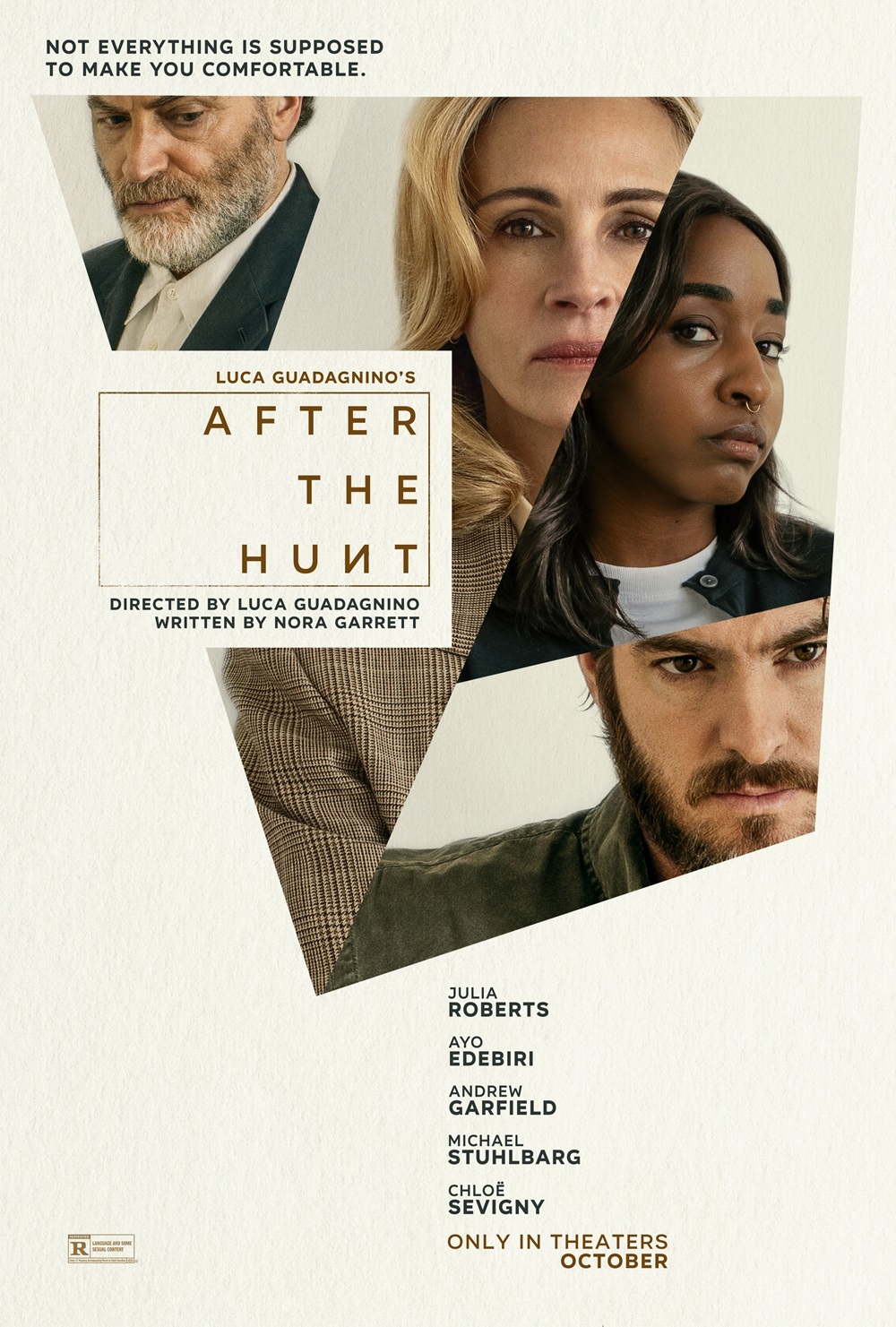
Does anyone have a firm hold on how not to offend? Luca Guadagnino raises his hand, he has an idea. The accomplished director offers up After The Hunt, a parable of the modern condition which asks – but never answers – many pertinent questions.
After The Hunt will irritate anyone who wants to point at the good guy and the bad guy on the screen and feel satisfied. In fact, the film’s message could be that all humans are hateful. Its psychobabble diatribes meets Woody Allen vibes are not for everyone.
Yet, this reviewer loved After the Hunt.
Part of that love stems from the characters. Julia Roberts shines as the morally flexible Alma, who seems so unhappy to be anchored by the trappings of a very nice life. Wealthy, beautiful and a Yale philosophy professor, all of Alma’s dreams will come true if she gets tenure. Pity she’s always vomming up the bile she holds for other humans, especially those unwilling to opine on Kierkegaard’s theories for fun. Her husband, Frederick (Michael Stulbarg) is also pretentious and yearning, a role Guadagnino loves to see him play. Fred is a psychiatrist who adores and coddles Alma, but his own acidic jealousy threatens to overwhelm him when Alma spends time with fellow tenure-seeker Hank (Andrew Garfield) or fawning PhD assistant Maggie (Ayo Edibiri). Hank is a handsome millennial who clawed his way through poverty to the academic elite, and is now enjoying all the rewards of being hot teacher. Whereas Maggie is an uber-rich bi doctoral student with a huge crush on Alma that outweighs her intellect but not her expectations.
The central theme of After the Hunt is a he said-she said about sexual decision-making (another favoured subject of Guadagnino), which goads the viewer into side-taking with the barest of factual evidence. Where the films excels is by dismissing that theme. Instead, perhaps its real forte is as a Rorschach Test for viewers to decide which maligned group they most identify with. And no minority or majority escapes unharmed. This film is not subtle. It’s Gen Z v Gen X, Patriarchy vs Witches or, at times, literally Black v White. The films lays out how the intersectionality of personal sleights muddies the water for every character. Each has a fatal flaw, each holds a fervent grudge.
Writer Nora Garrett‘s script skewers anyone in its path, not shying away from trans-narratives, the perils of the information age and how America conjured its own class system. Did they do it? Are they in the wrong? Who’s to blame here?
After the Hunt says it doesn’t matter, offering up a painful truism: we can be both victim and perpetrator at the same time.
Trailers
Support Live For Films
Follow Us




Advert
Recent Posts


Other Mommy – Jessica Chastain goes a bit Coraline in the new trailer for the Blumhouse horror movie


Film Festivals and Conventions






Check out these other sites